A non-PL quasi-comp output transistor question

First answer, either MJ15022 or MJ21194. Which ever I can get. Digikey had stock some weeks ago.

Good call on the outputs. The two I had in the left channel are blown.
Bring it up in safe mode without any outputs. Get the amp in control and then add outputs. With no load on the output, you should be able to finish your debug work on what is not operating properly. R626 and R627 feed the output node so you should be all set.
 
Thanks for the tip and I could do that except I still need something to put at Q603.

Must get horizontal now. I wiped out coming down a steep icy driveway earlier and my arse and albows are smarting.
 
Yup, I've been sitting, standing and bending very gently today.

Seems Digikey don't stock MJE15033's so I ordered from Mouser. But Mouser didn't have MJ15022's so I'm getting MJ21194's for the outputs.

Given ETA of between Dec 25 to Dec 30.
 
Yup, I've been sitting, standing and bending very gently today.

Seems Digikey don't stock MJE15033's so I ordered from Mouser. But Mouser didn't have MJ15022's so I'm getting MJ21194's for the outputs.

Given ETA of between Dec 25 to Dec 30.

The 94s are much preferred over the 022s so you did alright.
 
Give me an addrss and I'll send some TP9054/MJ15024 pulls priority mail so this can be put to bed and, I'll throw in silpads. Also, referring to the connections on the right side of the schematic, I'm curious what terminal 4 and T1, T2 are used for. T1 &T2 would seem to be test points. Terminal 4 looks like some sort of an output to an overload indicator.
 
Last edited:
Give me an addrss and I'll send some TP9054/MJ15024 pulls priority mail so this can be put to bed and, I'll throw in silpads. Also, referring to the connections on the right side of the schematic, I'm curious what terminal 4 and T1, T2 are used for. T1 &T2 would seem to be test points. Terminal 4 looks like some sort of an output to an overload indicator.

Thanks for the offer Don, but the money's already spent.

T1 & T2 are meter test points for bias adjustment. Terminal 4 connects via a wire directrly to the corresponding terminal 4 of the right channel board.

It is terminal (pin) 5 where there has been 35 volts feeding into the protection circuit board. There is nearly 0 volts at the same pin on the working right main amp board.
 
The 94s are much preferred over the 022s so you did alright.

Quite a surprise but the Mouser order arrived today.

The 2SA818 at Q603 now has an MJE15033 in it's place. Different pinout so was installed accordingly - flipped around and legs crossed. But it had no effect eliminating the voltage going to the protection circuit. Still (-)35 volts so still engaging.

And to confuse me further, the 2SA818 when pulled, checked as OK - again

I have not installed any of the new output transistors yet. There are none at all in the affected left channel and the right channel still has four good factory originals in place.

You mentioned....

....I was going to tell you to put 2 1N4148s in series and attach the anode of the pair to the collector of Q604 and the cathode at the emitter of Q604.
This will make the bias low but should allow for a safe bring up.


I can do that. And could it possibly change the consitent 0.0 volts that I've been getting at the bias test points? Partially rotating the bias adjustment pot, VR602, has yet to have any effect.

It seems I can also replace Q604 if it might be worthwhile. It's a 2SC1384 and I have found a list of transistor substitutions stating that a KSC2690 is a replacement for those and I have a few KSC2690's on hand.
 
Interesting. I have an RA-1412 that got blowed up when a tuner shorted 110ac to chassis. It was at the dickheads place who stole my RT-707 in pieces when I pulled all my gear out of there. I have no idea what stage of repair it was at and I’m not about to call him and ask as there’s a lawsuit heading his way... I may look at it after I finish with Tim, but it’s honestly way above my head... it was a real nice amp when it worked. I mostly used it for its pre amp section, but at 110wpc its a beefy integrated for sure. If anyone here would be interested in repairing it that could be an option too.
 
Did that tuner that shorted have a two-wire AC cord and plug? If so, it would be a good testimony for a three-wire cord with a ground pin. Likely that internal short would have caused the house circuit breaker to open and might have saved your Rotel amplifier.
Where is the amplifier now?
 
Did that tuner that shorted have a two-wire AC cord and plug? If so, it would be a good testimony for a three-wire cord with a ground pin. Likely that internal short would have caused the house circuit breaker to open and might have saved your Rotel amplifier.
Where is the amplifier now?
Yep old two wire plug. The Rotel is sitting on my couch rn.
 
Haha bumble fuck Prince Edward Island. Lee sent me the big carver by UPS using pops old work account which is roughly half regular charge, cost ~$68 so not ridiculous really.
 
Joe, I finally got to doing what you suggested....

....put 2 1N4148s in series and attach the anode of the pair to the collector of Q604 and the cathode at the emitter of Q604.
This will make the bias low but should allow for a safe bring up.


If there was supposed to be a change in voltage at pin 5 (still -35 volts) or allow altering the bias at the test points (still reads 0.0 volts), it did neither. I am unsure what you meant by a safe bring up.

The only thing I can think to do now is back track along the trace side of the board from pin 5 and try locating the source of that (-)35 volts that should not be there.

All I've got is a DMM to find where that voltage begins, it must be from somewhere.
 
The diodes were a method to prevent excessive bias which is probably what blew out your 2 outputs. Are you running without outputs at this point? That is the recommended approach.

What is the bias set procedure that you have been using? Is that something you can post?
 
Yes, all output transistors are out of the troublsome left channel.

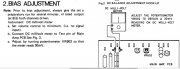
Below is the bias adjustment proceedure in the service manual. But since moving the pot in either direction does not alter the continual 0.0 volt reading, my naive assumption is that the (-)35 volts present at pin 5 must be eliminated first - find that problem and the board behaves....maybe?

It's been several weeks now but I adjusted bias on the right channel board more or less to 30mv.

Rotel RA1412 bias adjustment.JPG
 
Yes, all output transistors are out of the troublsome left channel.

Below is the bias adjustment proceedure in the service manual. But since moving the pot in either direction does not alter the continual 0.0 volt reading, my naive assumption is that the (-)35 volts present at pin 5 must be eliminated first - find that problem and the board behaves....maybe?

It's been several weeks now but I adjusted bias on the right channel board more or less to 30mv.

View attachment 46878
OK but what do those test points correspond to on the schematic? Can you trace the board to find out?
 
Hoo-boy!

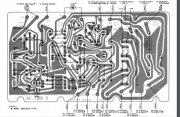
TP1 is where a (+) meter lead connects and looking at the trace side, there is a jumper that leads to two of the six 5W - 1 ohm resistors and also pin #8. According to the schematic, pin #8 goes to the emitter of output transistor Q001.

TP2 is for the (-) meter lead. It's trace splits into two arms. One arm encompases a number of resistors but it will take a bit of time for me to identify their designation.

The other arm includes pin #7 which the schematic says is to base of Q003 & Q004.

Also along that same arm is a resistor in parallel with an inductor identified on the scematic as L601 - RL102. It might be a useless observation but I thought it was interesting that the other end of that inductor/resistor combo terminates at pin #5 - where the high negative voltage is.

This will probably be far more succinct than my attempts at description. I'll clarify whatever I can and measure whatever you say.

Rotel RA1412 main amp trace side c.JPG
 
As time and patience allowed, I continue trying to find the fault with this board.

Something I recently did and probably should have done at the get go, was measure voltages at all the pins. Then identify, as Joe recommended, which components they lead to. I also noted what voltages should be present.

Then doing likewise with the functioning right channel board for comparison.

Everything on the right side more or less corresponds with the schematic. Still have a DBT in place so some actual readings were a bit below but (+) voltages were (+) voltages, (-) voltages were (-) voltages and millivolts were millivolts.

Not so with the troublesome left channel board. The (-)35 volts triggering protection via pin 5 is also present at:

~(-)35 volts @ pin 7 to collector of output transistor Q003 - diagram says 0 volts
~(-)35 volts @ pin 8 to emitter of output transistor Q001 - diagram says (+)0.06 volts
~(-)35 volts @ pin 9 to emitter of output transistor Q002 - diagram says (+)0.06 volts
~(-)35 volts @ pin 14 to base of output transistor Q001 - diagram says (+)0.65 volts
~(-)35 volts @ pin 15 to base of output transistor Q002 - diagram says (+)0.65 volts

~(-)35 volts @ pin 2 to cathode of heat sensing heatsink diode - didn't see diagram spec but right channel pin 2 reads (-)178 mv
~(-)35 volts @ pin 3 to anode of heat sensing heatsink diode - didn't see diagram spec but right channel pin 3 reads (+)1.8 volts

I am very likely trouble shooting all wrong but since contending with negative voltages in the wrong places, my thought was to identify the various transistors on the board that see -B negative volatages that are somehow linked to those pins.

That conclusion has made me focus on:

Q601 and Q602 - a pair of 2SA750's......I have read 2SA970's can replace those and I have some on hand.
Q605 and Q606 - a pair of 2SC1628's....I think KSC3503 can replace those. If so, I have those also.
Q610 - a 2SA814. This one was already replaced at some time in the past with a 2SB546A. By chance, the case split open of the corresponding 2SA814 on the right board. I replaced it with an MJE15033 after learning it was acceptible and I have more of them.

Any further insights or opinions are most certainly appreciated.
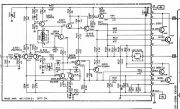
Rotel power amplifier board 2.JPG
 
Back
Top